
Whether you are a newbie or an expert in the world of business, you have probably heard of the term marketing strategy. It may sound intimidating specially for new business owners, but to make it simple, it is a game plan carefully developed to reach your target audience and convert them into loyal customers. This modern and fast-paced world has changed the way products and services are advertised. Having an effective and feasible strategy is an essential to stand out in the competitive market.
In this informative article, we will discuss what is a marketing strategy, why it is important, and how to create one that actually drives results.
A marketing strategy is an overview of a business' unique approach on how to attract, engage, and retain customers. It's all about identifying your target market, analyzing your competitors, and aligning your business goals based on these factors. Understanding consumer personas such as their usual preferences and what concepts resonate with them is essential in planning how your brand will meet their needs and how you can come up with a good value proposition. Think of it as a roadmap or a route that guides your business to take the right path and how to get there.
You can choose from a lot of marketing approaches depending on your product or service and where your audience usually spends time. It can be search engine optimization, social media marketing, or email marketing. Aside from these techniques, it is also helpful to consider the Ansoff's matrix which focuses on the 4P's or what they call the marketing mix. This pertains to the product, place, price, and promotion. This matrix is more of a strategic planning that helps businesses and companies decide how to grow. It highlights these four key strategies:
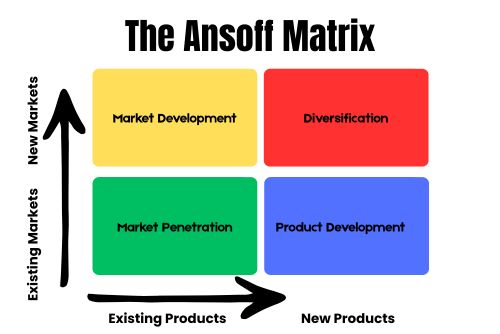
Based mostly on existing products and existing markets, this strategy focuses on increasing the sales of products you already have in your existing market. It's a less risky method that only involves boosting marketing efforts, adjusting pricing, improving customer service, and encouraging more engagements from repeat customers. One perfect example is a coffee shop offering loyalty cards to attract more customers.
In this approach, a business or a company makes new product innovations to sell to its current market. Even though it's a risky strategy, it encourages a deeper buyer-business relationship. For example, a smartphone company releases a new smartwatch to match with their existing in demand phones.
Market development involves venturing into new markets with already existing products by targeting new locations, new customer base, and new distribution channels. A good example is a local fashion brand who decides to sell on the national level for the first time. Sounds a bit risky due to more investments and efforts, but with thorough planning and the right approach, it will eventually benefit the business.
Probably the riskiest strategy which requires development of new products to be sold to a new target audience. Despite the high risk, it offers high potential for growth when done right. This strategy can be classified as related diversification which means building an expansion related to the existing business or an unrelated diversification which involves moving into entirely something different. For example, a car manufacturer releases an electric scooter business in urban markets.
Think of a car without enough fuel. Surely it will encounter problems along the road and it won't be able to reach far places. The same analogy can be applied to a business and an effective marketing strategy. With a well-structured strategy, a business owner can stay focused on their clear goals while using their resources more effectively. It can also encourage good communication with your customers which will help you measure your success and make adjustments if needed. Here are the different types of notable marketing strategies that work with the recent trends in the market today:
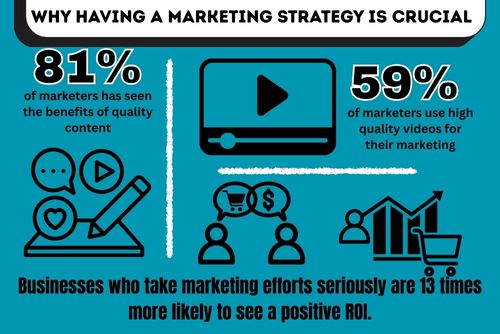
According to statistics from the New York Times, 81% of marketers has seen numerous advantages from creating interactive content. Not only is it low cost, but it is a marketing strategy that offers a long-term impact. It is also found that videos are the most used content format with 59% of marketers using high quality videos for their content marketing. Businesses who take marketing efforts seriously are 13 times more likely to see a positive ROI. The bottom line is that implementing your strategy is more than just running ads or posting on social media; it's the bigger picture that bonds all your marketing activities together. So be sure to formulate strategies that match your business and services.
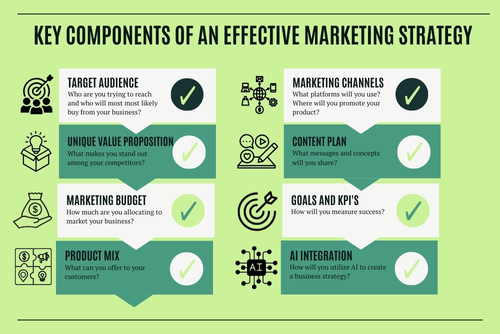
Every winning marketing strategy is a mixture of all essential components tied together to yield best results. It doesn't have to be complicated and it only needs to have these important details:
Completing your marketing strategy with all this information will indeed boost your company's reputation, sales, and visibility. Using these strategies efficiently helps you work smarter, not harder.

Learning how to create a feasible yet effective marketing strategy is crucial to prepare for your company's success. To create one, let us break down the important steps to further understand what is a marketing strategy.
Having a clear grasp of your main business goals and marketing objectives will help you move towards growth and expansion. It may be very tempting to have goals like "gain more followers" or "increase sales." But for your marketing strategies to work, you must set a SMART goal (Specific, Measurable, Attainable, Realistic, Time-Bound). For example, "grow our email list by 20% in six months" is a goal that is easy to plan out and track.
Strategic marketing requires thorough research and understanding of your target market and competitors. Start by creating customer personas or a detailed profile of your ideal customers. Consider their age, location, interests, needs, and buying habits. Additionally, analyze your competitors strengths, weaknesses, and value proposition to give you an idea of the tools and strategies you'll need for the next step. Alongside these factors, it is beneficial to also look out for the market size, market gaps where you can provide value, and potential economic realities that has a long-term impact.
After researching about the market, it is now time to focus on developing a better product or service to satisfy the needs of your customers. Doing business is not just about coming up with a product and selling them to anyone, but it is more of offering solutions that are beneficial to your target audience. Most of the time, people do not point their attention to product features. Rather, they will look at its benefits and how it will help them with their day to day activities.
As you position your product to meet the demands of your ideal buyers, promote a brand messaging that will surely resonate with them. Communicate to your potential buyers by providing accessible solutions to their problems and improving their way of life. Compare what you can offer to that of your competitors to see where you are positioned and show them that yours is better. Also, don't forget to use the right platform to channel your message and follow industry trends that will surely make you stand out.

Communication works best when the right platform is used. As you proceed to spread your message and advocacy to the right people, research about where they usually spend time and where they are active. Are they scrolling on Pinterest for artistic inspiration? Do they use Google to find solutions? Or are they into reading blogs and watching relevant reels?
Choosing the right marketing channel and platform to use will help you determine the resources you need to make it possible. There's no need to waste your time and effort on TikTok when your target customer base is primarily on LinkedIn. Some may utilize other platforms so it is important to find the suitable space for you to market your product or service.
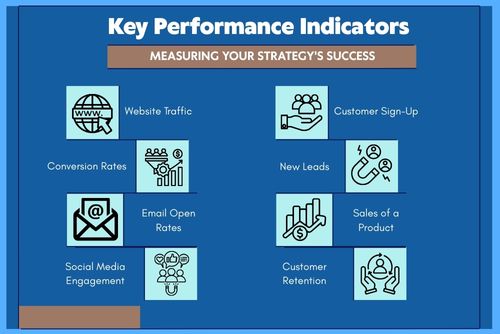
Tracking your progress is definitely part of the process. To know whether your marketing strategy is working or not, consider analytics as your best friend. Take enough time to review your campaign's performance to assess strengths and weaknesses, and adjust strategies if necessary. Here are examples of metrics to look out for:
A marketing strategy is definitely not a one-size-fits-all. To tailor your approach, you need to carefully look at the numbers and metrics that will determine the areas where you need to improve to keep your business running.
You probably heard about a marketing plan as you start your small business and wonder how is it related to a marketing strategy. Do not confuse yourself because they are two different things. To make things less confusing, a marketing plan answers the how and when of a business such as the platform to be used, campaign and content calendar, budget, and metrics. It is simply a detailed view of specific actions you need to execute your strategy. On the other hand, a marketing strategy is simply a high-level program that sets the direction and long-term goals. It answers the questions "what are we trying to achieve?" and "who is our target audience?"
To summarize, a marketing strategy is the foundation that guides every decision and action for your business. It helps you grow your brand, reach the target audience, and achieve business goals in the most effective way. As you learn more about what is a marketing strategy, you realize why it is essential for business growth, what are the key components you need to incorporate, and how to track your progress. There are also a number of strategies to choose from and your choice should depend on your branding, product, and message. Weaving all these factors together will boost your business' visibility and increase your sales in the long run.

Ronald Osborne is an Australian entrepreneur and experienced business coach. With over ten years of business and mentoring experience, an MBA specializing in Finance, along with launching/partnering with over 10 of his own companies around the globe, he has been able to achieve his version of success. Ronald has been able to help large telecommunication companies, law firms, trade businesses, and everyday business owners improve their business and take it to the next level.


