
Ever had a brilliant New Year's goal crumble by February? Yeah, me too. Years ago, I vowed to grow my business while prepping a complicated lasagna - let's just say, both the lasagna and my goal-setting got burnt. Since then, I've coached everyone from skeptical chiropractors to ambitious entrepreneurs using my free SMART goals template that actually stick. If you want wild stories, concrete action steps, and the goal-tracking spreadsheet I swear by, you're in the right place.
TL;DR: If you've ever set a goal and let it gather dust, this guide reimagines SMART goals in a way that's raw, practical, and fun - backed by real stories, a killer tracking template, and strategies designed for actual humans (not robots). Download the tracker, steal my best goal-setting moves, and watch those resolutions finally get done.
Let me take you back to what I call the infamous “lasagna-and-goal-setting disaster.” It was January, and like most people, I was riding high on New Year’s motivation. I had a fresh planner, a stack of sticky notes, and a head full of big dreams for my business. I also had a bubbling lasagna in the oven. In my mind, I could easily juggle both: cook dinner and map out my entire year’s worth of goals. Spoiler alert: I ended up with a burnt dinner and a pile of half-baked goals that never saw the light of day.
Why am I telling you this? Because multitasking nearly tanked my business aspiration that year. I thought I could set meaningful goals while distracted, but all I did was scribble vague ideas like “grow my business” and “get more clients.” Sound familiar? If you’ve ever written down a New Year’s resolution and forgotten about it by February, you’re not alone. In fact, research shows that over 80% of people abandon their resolutions within six weeks. I was one of them, and maybe you have been too.
Here’s what I learned from my lasagna fiasco: the problem wasn’t just that I was distracted. The real issue was that my goals weren’t SMART - they weren’t Specific, Measurable, Achievable, Relevant, or Time bound. I wrote down what I wanted, but I didn’t give myself a clear path to get there. And that’s exactly why most people - doctors, coaches, entrepreneurs, and yes, even business coaches like me - stumble over the same vague goals year after year.
Without clarity, your brain doesn’t know what to focus on. It’s like asking your GPS to take you “somewhere nice” - you’ll end up lost or, worse, going in circles. That’s exactly what happened to me. My goals were so broad that I didn’t know where to start, so I never did. By February, my planner was collecting dust, and my business was stuck in the same place it had been the year before.
Here’s the wild truth: there’s no shame in failing at your goals. In fact, your setbacks are full of hidden clues about what actually works for you. When I looked back at my lasagna-and-goal-setting disaster, I realized I needed to treat my business goals with the same focus and care I’d give to a patient or a client. I couldn’t just “fit them in” between other tasks. I needed to carve out dedicated time, use a proven system, and get specific about what I wanted to achieve.
“If you treat your goals like an afterthought, they’ll stay that way - forgotten and unfinished.”
That’s why I created my SMART goals tracker. It forces you to get clear, get focused, and get real about your objectives. And it’s why I walk my clients - chiropractors, coaches, and entrepreneurs - through each step, so they don’t make the same mistakes I did.
Whether you’re a doctor launching a new clinic, a coach growing your client base, or an entrepreneur scaling your business, the pattern is the same. We all want big results, but we rarely take the time to define what “big” actually means. We write down dreams, not plans. And when life gets busy (or the lasagna burns), those dreams get pushed aside.
But here’s the thing: your failures aren’t the end. They’re the beginning of a smarter, more focused approach. If you’ve ever felt embarrassed about abandoning your goals, remember - every setback is a signpost pointing you toward a better system. And that’s exactly what the SMART framework is designed to give you.
If you’ve ever set a goal that fizzled out by February, you’re not alone. Most guides on SMART goals make it sound like a magic bullet, but here’s the wild truth: the framework is powerful, but only if you use it right - and most people don’t. Let’s break down what really works, what doesn’t, and the surprises I’ve discovered coaching chiropractors and business owners just like you.
Here’s what you won’t hear in the average blog post: SMART goals can be just as useless as vague resolutions if you don’t get brutally honest and specific. I’ve seen so many people fill out a SMART worksheet, check all the boxes, and still get nowhere. Why? Because they skip the hard part: making each step uncomfortably clear and actionable.
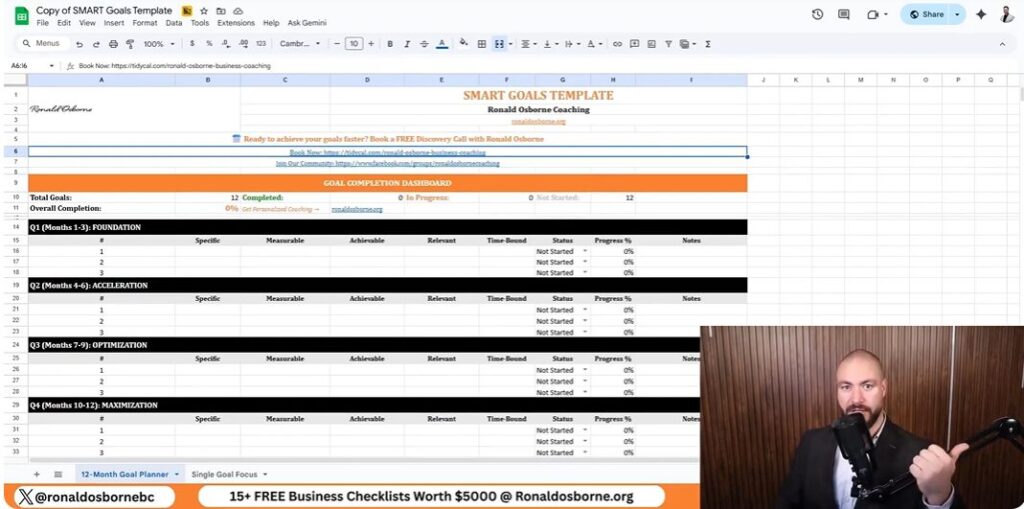
Let’s get real: “I want more clients” is a wish, not a goal. It gives you nothing to aim for, nothing to measure, and no urgency. Instead, try this: “I want to sign 15 new clients by March 31 using Google Ads, Facebook Ads, and referrals.” Now you have a target, a timeline, and a strategy. That’s a goal you can actually work toward - and track in my SMART goals tracker.
Here’s a story I’ll never forget. Years ago, a client came to me wanting to triple their revenue in three weeks. They were fired up, but the numbers just didn’t add up. We mapped out the math, looked at their current capacity, and it became clear: this wasn’t just ambitious - it was impossible. We had to dial it back and set a goal that stretched them, but didn’t break them. That experience taught me the hard way that “achievable” isn’t about playing it safe - it’s about being honest with your resources, time, and energy. If you skip this step, you’re setting yourself up for frustration and burnout.
So, when you’re using my SMART goals tracker, don’t just fill in the blanks. Push yourself to get specific, use real numbers, check if your goal is truly achievable, make sure it matters to you, and set a deadline that gets you moving. That’s how you turn a spreadsheet into a six-figure practice - just like Dr. Sarah did.
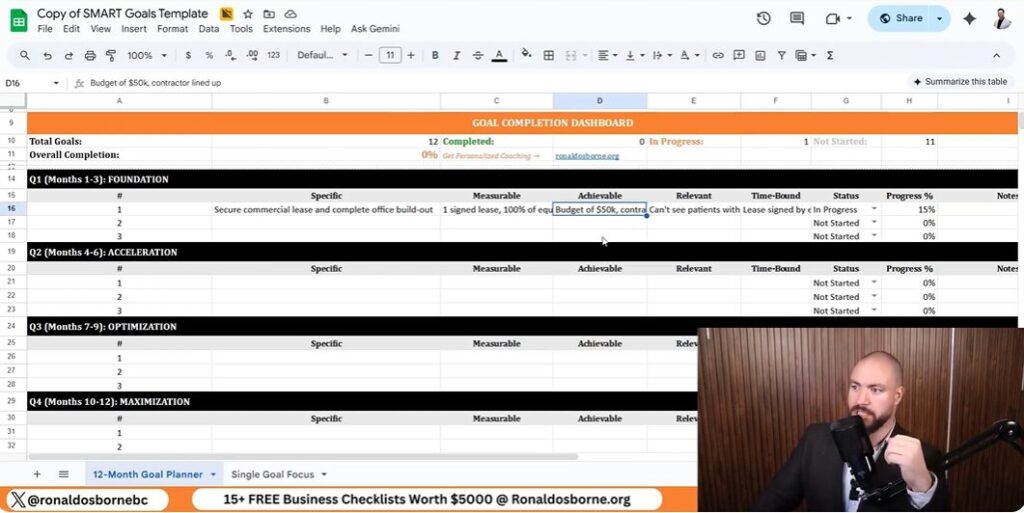
If you’ve ever set a New Year’s resolution only to forget about it weeks later, you’re not alone. That’s why I created my SMART goal tracker - a tool I use with every coaching client to break down big dreams into actionable steps. Let me walk you through exactly how to use this free SMART goals template, using a real-world chiropractic example, so you can see how it turns vague intentions into real, measurable progress.
My tracker is designed to move you from a broad vision to specific, trackable actions. Here’s how it works:
To keep you organized and laser-focused, my template has two tabs:
Most people abandon their goal spreadsheets because they don’t see progress. My tracker solves this with simple, visual progress metrics:
This approach keeps you engaged and accountable. Every update is a mini-win that motivates you to keep going.
Let’s look at how Dr. Sarah used the tracker for her Q1 milestone:
| Quarter | Milestone | Budget | Deadline | Progress |
|---|---|---|---|---|
| Q1 | Secure lease and complete buildout | $50,000 | March 31 | In Progress (70%) |
| Q2 | Acquire first 20 clients | $5,000 (marketing) | June 30 | Not Started |
| Q3 | Hire front desk and support staff | $10,000 | September 30 | Not Started |
| Q4 | Reach $10,000/month revenue | Ongoing | December 31 | Not Started |
By breaking down the year into clear, achievable chunks and tracking every step, Dr. Sarah transformed her vision into a thriving, six-figure practice. You can do the same by following this SMART goal system - one milestone, one update, one win at a time.

If you’ve ever felt like you’re stuck in a rut with your goals, let me share a wild truth: sometimes, the real magic happens when you chase a goal that seems totally unrelated to your business. I know this sounds counterintuitive, but hear me out. A few years ago, I decided - on a whim - to learn how to juggle during my lunch breaks. No, it wasn’t because I wanted to join the circus. I just wanted to see if I could do it. What happened next shocked me: that silly little sidequest gave me a burst of energy, focus, and confidence that spilled over into my coaching sessions, my client calls, and even my own business planning. Suddenly, I was hitting my targets faster and with more enthusiasm than ever before.
Here’s the thing: setting goals without tracking them is like throwing spaghetti at a wall and expecting a Michelin star meal. Sure, it’s fun to toss things around, but it’s messy, random, and you’re not likely to end up with anything you’d want to serve to guests. The same goes for your chiropractic practice. If you’re just setting goals in your head or scribbling them on a napkin, you’re missing out on the real power of the process. Tracking your progress - whether it’s through my free SMART goals template or another system - turns chaos into clarity. It’s the difference between hoping for results and actually seeing them stack up, week after week.
Let me get real with you for a moment. Over the years, I’ve had my fair share of coaching bloopers. There was the time I thought tracking daily water intake was a waste of time - until I realized my energy levels (and, yes, my productivity) skyrocketed when I stayed hydrated. Or the time I dismissed the idea of a “gratitude journal” as fluffy nonsense, only to discover that jotting down three things I was grateful for each morning made me more resilient when business got tough. These little “sidequests” didn’t seem important at first, but they ended up being the glue that held my bigger goals together. They gave me momentum when I needed it most.
So, what’s the takeaway for you as a chiropractor or business owner? Don’t be afraid to set a SMART goal that feels a bit outrageous or even unrelated to your main business objectives. Maybe it’s running a 5K, learning a new language, or finally tackling that stack of unread books on your nightstand. The key is to make it specific, measurable, achievable, relevant, and time bound - just like we discussed earlier. Track your progress in the same way you would for your business goals. You might be surprised at how much momentum you build in all areas of your life.
Here’s my challenge to you: pick one SMART goal that’s just a little outside your comfort zone. Set it, track it, and - most importantly - share your results with me. Yes, I’m serious. Email me your outrageous goal and your progress. I actually read every message, and I’d love to celebrate your wins (and maybe even feature your story in a future post, with your permission).
Remember, the wild truth about goal-setting is that it’s not just about the big, obvious targets. It’s about the sidequests, the tracking, and the willingness to try something new - even if it feels a little silly at first. That’s where the real breakthroughs happen. So grab my SMART goals tracker, set your sights on something bold, and let’s make this year the one where you don’t just set goals - you crush them.

Ronald Osborne is an Australian entrepreneur and experienced business coach. With over ten years of business and mentoring experience, an MBA specializing in Finance, along with launching/partnering with over 10 of his own companies around the globe, he has been able to achieve his version of success. Ronald has been able to help large telecommunication companies, law firms, trade businesses, and everyday business owners improve their business and take it to the next level.