
A few years back, I nearly opened my business next door to a top-rated competitor - talk about awkward introductions! That experience shoved me down the competitor analysis rabbit hole, where I learned that gut instinct isn’t always the best business tool. In this post, I’ll walk through my real-life process for pulling competitor data, judging their threat levels, and actually enjoying the detective work it takes to set your business up for a win. I’ll show you my spreadsheet tricks, unexpected discoveries, and why sometimes, the best business move starts with a good map (and, let’s be honest, a strong cup of coffee). Learn how to find business competitors effectively using this amazing tool I've created.
TL;DR: If you want to spot and outsmart local competitors, my free Google-based analysis sheet gives you the power to pull up detailed data, map threats, and find business openings in minutes - no guesswork required (and it won’t cost you a dime).
Let me start with a quick story. Years ago, I almost made a rookie mistake: I was about to open a new office for my consulting business in what seemed like a prime location. The foot traffic was great, the rent was fair, and the area looked promising. But just before I signed the lease, I did a quick competitor check using my own analysis tool. That’s when I realized I was about to set up shop right next door to a five-star competitor with hundreds of glowing reviews. If I hadn’t checked, I would have been “that guy” - the one who walks into a market already dominated by a local legend. That close call taught me a lesson I never forgot: guessing about your competition is a gamble you can’t afford in business.
Too many business owners rely on gut instinct or casual drive-bys to size up the competition. I’ve seen it time and again - people assume they know the local landscape because they’ve walked the block or checked Google Maps once or twice. But in reality, competitors can be tucked away on side streets, hidden in co-working spaces, or operating under slightly different names. If you’re just guessing, you’re flying blind. In crowded markets, this is a recipe for disaster. You could end up investing thousands in a location that’s already saturated, or worse, right next to a business with a loyal customer base and a killer reputation.
This is where technology changes the game. By tapping into the Google Place API through a custom-built spreadsheet, I can instantly uncover up to 200 local competitors - many of whom would never show up in a casual search. The API pulls real-time data directly from Google Maps, listing businesses by category, location, ratings, and reviews. This isn’t just a list; it’s a living map of your competitive landscape. With one click, you see who’s nearby, how strong their online presence is, and what kind of threat they pose to your business. It’s like having x-ray vision for your market.
Let’s be honest: walking the neighborhood or scrolling through Google isn’t enough. You’ll miss businesses that don’t have flashy storefronts or those that operate by appointment only. My tool maps every competitor within your chosen radius, ranks them by threat level, and even highlights opportunities where the competition is weak. You can see at a glance which areas are oversaturated and which are ripe for growth. This kind of data-driven insight simply isn’t possible with old-school methods.
In today’s hyper-competitive world, competitor analysis isn’t optional - it’s essential for survival.

Let me walk you through my favorite business hack: a competitor analysis tool that lets you pull up to 200 local rivals in under a minute - no coding, no tech headaches, just a Google API key and a few clicks. Whether you’re a contractor, accountant, or any local business owner, this tool is designed to give you a clear, data-driven look at your competition and help you spot real opportunities for growth.
This tool isn’t just for one industry. Whether you’re a plumber, accountant, dentist, or boutique owner, you can tailor the category input to match your business. The key is using Google-recognized categories for accurate results. If you’re not sure, Google your business type and see what comes up in the map listings - use that exact phrase.
Once the script runs, head to the Results tab. Here’s where the magic happens:
Even if you’re not a data nerd, this makes it obvious where the competition is fierce - and where you might have a golden opportunity. If most nearby businesses are low threat and your digital marketing is strong, you’re likely in a great spot for growth.
For more resources, reviews, and a free discovery call, visit RonaldOsborne.org. This tool is your shortcut to smarter, faster business decisions - no guesswork required.

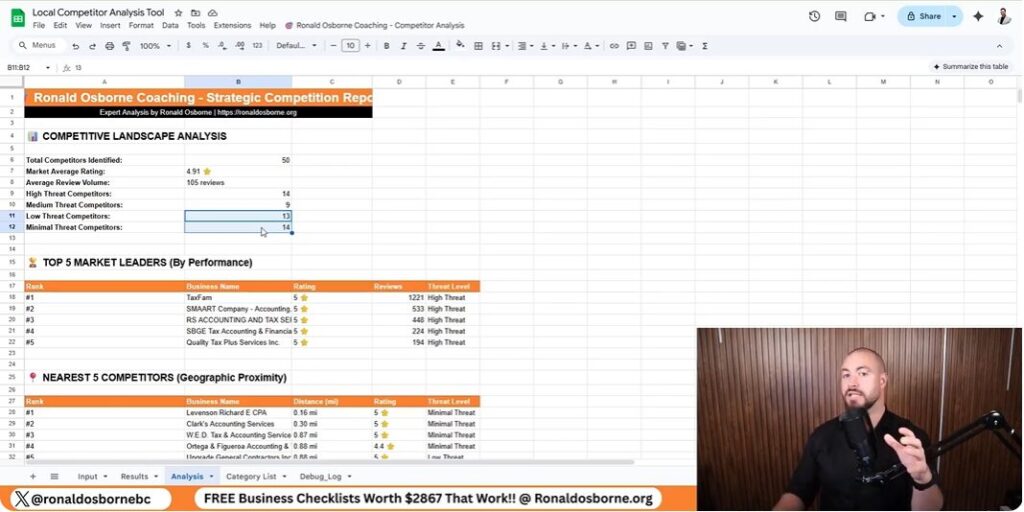
Once the competitor analysis tool finishes running, you’ll land on the Results tab. Here’s where the real insights begin. The spreadsheet lays out a table of local businesses, each with columns for name, ratings, number of reviews, threat level, distance (in kilometers and miles), address, and business type. The threat level is calculated based on how close a competitor is, how many reviews they have, and their average rating. High threat means a nearby business with lots of positive reviews; low threat might be a business further away or with poor ratings.
With the data in front of you, the next step is decision-making. If you see a cluster of high-threat competitors within a mile, each with hundreds of five-star reviews, it’s a red flag - especially if you’re new to the area. In this case, you might consider:
On the other hand, if most competitors are low threat - few reviews, low ratings, or further away - you’re likely looking at a growth opportunity. The summary at the bottom of the sheet gives you a quick breakdown of threat levels, helping you spot trends at a glance.
Let’s say I’m an accountant considering a new office in Pompano Beach. I drop my pin, run the tool, and see 50 competitors. The Analysis tab highlights the top five: three are within a mile, all with over 100 reviews and 4.8-star ratings. But surprisingly, 20 others are low threat - few reviews, low ratings, or further away. This tells me the area is competitive, but not impossible. If I can differentiate my services or outshine the weaker players with better digital marketing, I have a real shot.
One thing I learned: distance isn’t always what it seems. In some cities, a mile can mean a different neighborhood, demographic, or even a different set of customer expectations. If a rival a mile away has glowing reviews and dominates local search, they might as well be next door. Always look at both the numbers and the map - sometimes, the real threat isn’t the closest, but the most loved.
When I first built my custom Google spreadsheet competitor analysis tool, I intended it for one thing: to help business owners like you quickly know how to find business competitors. But as I dove deeper, I realized this tool is far more than just a spreadsheet - it’s a Swiss Army knife for smart business decisions. Here’s how you can use it to go beyond basic competitor mapping and truly sharpen your business edge.
One of the most powerful uses of this tool is for choosing where to set up shop. Let’s say you’re an accountant thinking about opening a new office. By dropping your pin on the map and running the analysis, you instantly see who’s nearby, how strong their reputations are, and whether the area is oversaturated or ripe for growth. The tool’s threat scoring system - factoring in proximity, reviews, and ratings - gives you a clear, data-backed snapshot. Instead of guessing or relying on word-of-mouth, you’re making decisions based on hard numbers and real-time data.
SEO can be a big investment, so it makes sense to know what you’re up against before you start. With the competitor analysis tool, you can see exactly who dominates the local search results and how tough the competition is. If you notice that most nearby businesses have weak digital footprints (few reviews, low ratings), you know you can make a splash with a strong local SEO campaign. On the flip side, if the top five competitors are digital powerhouses, you might need to rethink your strategy or location. This approach saves you money and helps you focus your marketing where it’ll have the most impact.
Before you commit to a new location, service, or marketing push, use the tool to scope out the landscape. The spreadsheet doesn’t just list competitors - it highlights opportunities. For example, if you see a cluster of low-threat businesses in a high-traffic area, that’s a green light for investment. If the market is crowded with high-threat players, you might want to pivot or find a niche. This kind of data-driven due diligence is what separates smart moves from costly mistakes.
Numbers matter, but so does your gut. I always recommend using the insights from the tool alongside your own experience and instincts. Maybe the data says a location is competitive, but you know the community or have a unique angle. Use the spreadsheet as your foundation, then layer on your personal knowledge for a more accurate, human-centered decision.
Your online reputation isn’t just a vanity metric - it’s a business asset. Alongside the competitor analysis tool, I offer free brand monitoring resources on my website. These tools let you track web mentions and reviews, so you always know how your business is perceived. Staying on top of your digital presence can help you spot issues early, respond to feedback, and build trust with new customers.
After running my local competitor analysis tool and seeing the data laid out so clearly, you’d think the path forward would always be obvious. Numbers don’t lie, right? But here’s a true - and slightly odd - lesson I’ve learned after years of helping business owners: sometimes, even the sharpest data can miss the stubborn power of gut feelings and neighborhood rumors. Data gives you the map, but your instincts and local knowledge help you read the terrain.
Let me share a quick story that really drove this home for me. A few years back, I was helping a client scout locations for a new fitness studio. We ran the competitor analysis tool, and one nearby gym popped up as a “minimal threat.” Their reviews were average, their digital presence was weak, and their customer base seemed small. On paper, they looked like a non-issue. But something about the location felt off to me. The parking lot was always full, and I kept hearing their name pop up in local Facebook groups. So, I decided to do a little old-school research - drove by, chatted with a few locals, and even stopped in for a class. That’s when I learned the owner was about to merge with a popular local trainer, instantly doubling their membership and expanding their services. Within weeks, that “minimal threat” competitor became our toughest rival, and the data hadn’t seen it coming.
This experience taught me that while tools like my Google Place API-powered spreadsheet are incredibly powerful, there’s no substitute for boots-on-the-ground research. The numbers can tell you who’s nearby, how many reviews they have, and how close they are to your target spot, but they can’t always capture the buzz of a new owner, the loyalty of a local following, or the impact of a surprise merger. Sometimes, the best insights come from a quick chat with a barista, a tip from a neighboring shop owner, or just trusting your Spidey sense when something doesn’t add up.
So, as you explore how to find business competitors using this tool to map out your market, remember to balance the hard data with a dose of wild card wisdom. Don’t skip the in-person scouting, the casual conversations, or even those gut feelings that tell you to dig a little deeper. The most successful business owners I know are the ones who blend data-driven decisions with real-world intuition. They use the spreadsheet to narrow the field, then let their instincts and local knowledge guide the final choice.
In the end, business survival isn’t just about knowing the numbers - it’s about reading between the lines, listening to the whispers, and having the courage to trust your gut when the data leaves a gap. Combine both, and you’ll not only find your place in the market - you’ll thrive in it.

Ronald Osborne is an Australian entrepreneur and experienced business coach. With over ten years of business and mentoring experience, an MBA specializing in Finance, along with launching/partnering with over 10 of his own companies around the globe, he has been able to achieve his version of success. Ronald has been able to help large telecommunication companies, law firms, trade businesses, and everyday business owners improve their business and take it to the next level.